The Unseen Drama of Day 3: Why the 2026 Commonwealth Games Are Already Unraveling
Sports thrive on unpredictability, but the 2026 Commonwealth Games in Glasgow have delivered something even better: a masterclass in human fragility, resilience, and the quiet chaos lurking beneath the surface of Olympic-caliber competition. As Day 3 dawned at the Tollcross International Swimming Centre, the air wasn’t just thick with chlorine—it crackled with tension, unspoken narratives, and the kind of drama that makes you wonder if athletes ever truly sleep before big meets.
The Weight of Expectation: When Records Become Shackles
Let’s talk about Mollie O’Callaghan. The Australian phenom arrives here as the top seed in the women’s 100 freestyle, but her recent 52.33 at Trials now feels like a cruel joke. A back injury has turned her into a question mark, and that’s what fascinates me most. Elite athletes are trained to compartmentalize pain, but watching her lag behind her June form raises a deeper issue: how much of “peak performance” is mental? I’ve always argued that the body breaks down long before the mind does—it’s the fear of failure that corrodes technique first. Shayna Jack, meanwhile, seems to thrive in this twilight zone. Her relay splits last night (52.42) weren’t just fast; they were defiant. At 35, she’s rewriting the playbook on what “retirement age” means in swimming. Good for her. Let’s hope the 100 free prelims become her final mic drop.
Relay Chaos and the Curious Case of Canada’s Missing Swimmers
Speaking of relays: Canada’s mysterious disappearance from the 4×200 free team is either a strategic bluff or a logistical nightmare. Leaving lanes empty in previous relays isn’t just odd—it’s borderline existential. Do they lack four competent 200 freestylers? Or are they sandbagging, hoarding energy for some grand finale? From my perspective, this reeks of poor planning. At major meets, depth matters. Canada’s coaching staff might want to audit their roster before the medal table becomes a referendum on their competence. Contrast this with Australia’s ruthless efficiency—O’Callaghan, Jack, and Harris are basically a three-headed hydra in the pool—and you see why relays are as much about psychology as speed. Terrorizing opponents with unmatched depth? That’s the Australian way.
Sam Williamson vs. Adam Peaty: The 50 Breast That Could Redefine Legacies
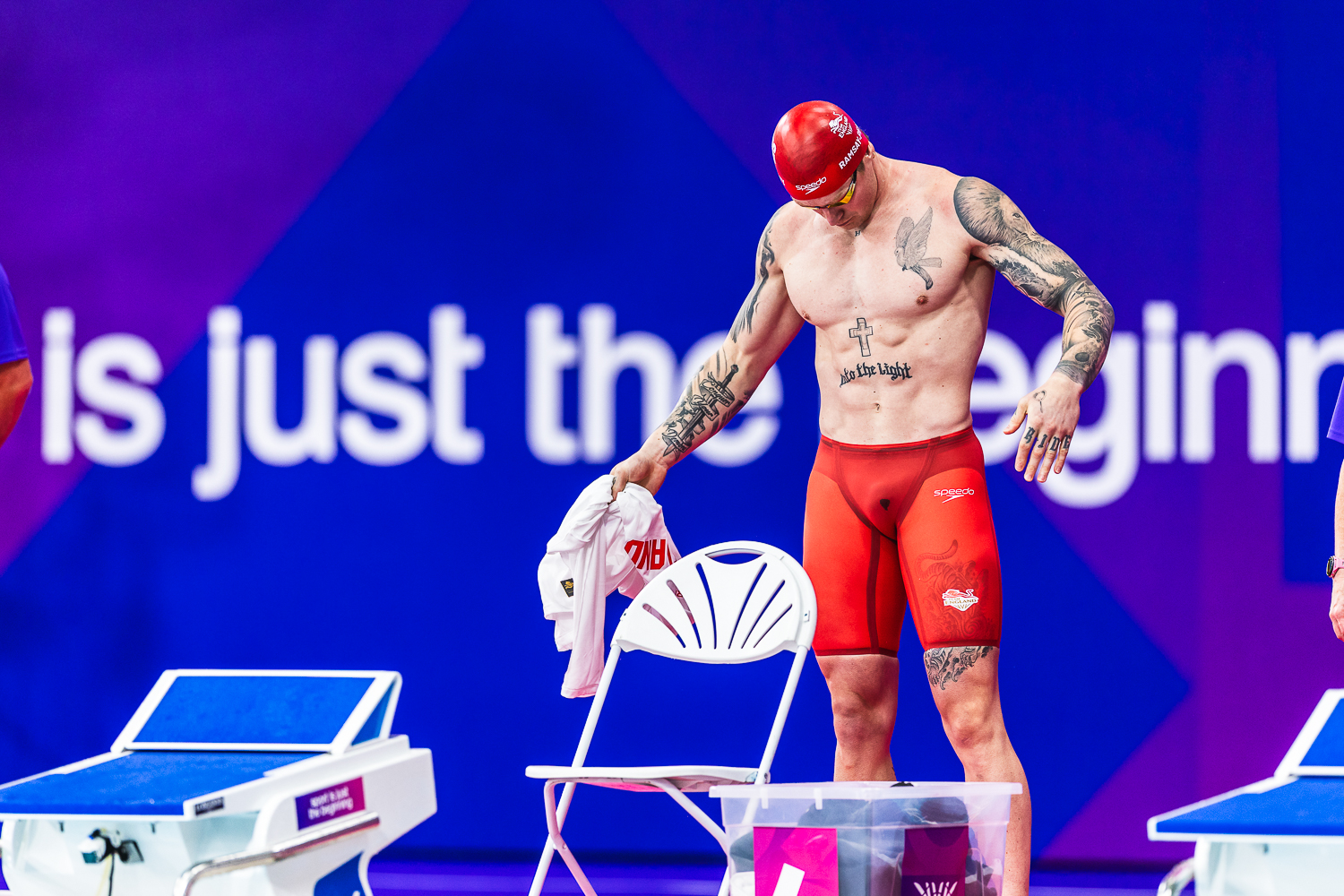
Nowhere encapsulates the Games’ raw drama like the men’s 50 breast. Sam Williamson (26.61) and Adam Peaty (26.64) are separated by 0.03 seconds—a margin so thin it could be erased by a sneeze. But here’s what everyone’s missing: Peaty’s world record (26.64) isn’t just a number. It’s a psychological weapon. Williamson might have beaten him in the 100 breast final, but sprinting is a different beast. I’ve long believed Peaty’s greatest strength isn’t his power—it’s his ability to make rivals doubt their own strokes. Will Williamson crack under that invisible pressure? Or has the Australian’s recent form (his 26.61) erased Peaty’s aura of invincibility? This race isn’t about gold; it’s about who gets to rewrite history.
The Alice Tai Paradox: Dominance in a Shifting Classification
Alice Tai’s dominance in the women’s S9 100 back (1:10.55) is impressive, sure—but let’s interrogate why. The event moved up a classification from S8, theoretically making the field “stronger.” Yet Tai still领跑? That’s not just talent; it’s a rebuke to the very idea of categorization in para-swimming. I’m not saying classifications should be abolished, but Tai’s performance exposes their limitations. How do you quantify ability when one athlete outpaces the framework designed to contain them? Her gold here feels inevitable, but the real story is the quiet revolution she represents: the blurring of lines between “disability” and “superhuman.”
The Bigger Picture: Why Glasgow 2026 Matters Beyond the Medals
Three days in, and the Commonwealth Games are already revealing their true purpose. This isn’t just a competition—it’s a stress test for post-pandemic sports. With the Olympics looming, athletes are treating Glasgow as a low-stakes lab: tweak techniques, experiment with pacing, and gauge rivals’ weaknesses. Take Pieter Coetze and Ollie Morgan’s 200 back duel. Their 1-2 in the 50 back wasn’t just a race; it was a chess move. They’re signaling readiness for Paris 2028. Meanwhile, the absence of traditional powerhouses like the U.S. and China turns these Games into a petri dish for emerging nations. Kyra Rabess (CAY) in the 1500 free? Her 17:05.02 isn’t just a personal best—it’s proof that smaller nations are closing gaps faster than anyone predicted.
Final Thoughts: The Beauty of Imperfection
By the time the 4×200 free relay wraps Day 3, we’ll have seen everything that makes sports addictive: triumph, collapse, strategy, and the occasional organizational snafu (looking at you, Canada). But what sticks with me isn’t the times on the scoreboard—it’s the humanity beneath them. O’Callaghan’s injury, Peaty’s fading aura, Jack’s defiance—these are the stories that outlast medals. In my opinion, the Commonwealth Games’ greatest trick isn’t uniting nations; it’s reminding us that perfection is boring. Give me flawed, fighting athletes any day. After all, if victory were guaranteed, why would we watch?